
For the most straightforward craft-market experience in San Miguel de Allende, start with Mercado de Artesanías on Andador Lucas Balderas. If you want everyday market life and food as well as some craft shopping, add Mercado Ignacio Ramírez next door. For galleries, artist studios and more curated design shopping, Fábrica La Aurora is a different format and deserves its own stop.
Details checked September 18, 2026. Opening times, holiday schedules, individual vendors, card acceptance, accessibility and shipping services can change. Confirm time-sensitive details with the venue or seller before making a special trip.
Choose the right kind of craft-shopping stop
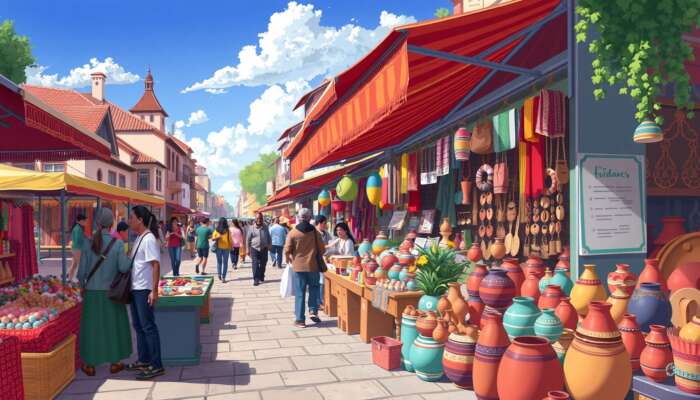
San Miguel de Allende offers several different shopping formats, and they are not interchangeable. A traditional craft market is best for browsing many stalls in one place; a municipal market mixes everyday shopping and food with some craft goods; an art-and-design complex focuses more on galleries and studios; boutiques offer a curated retail experience.
| Format | Best for | What to expect | Main trade-off |
|---|---|---|---|
| Craft market | Browsing many craft stalls efficiently | Textiles, metalwork, decorative objects, jewelry and souvenirs can appear side by side | Origin and maker can vary by stall, so ask before assuming an item was made locally |
| General municipal market | Food, flowers, produce and everyday local-market atmosphere | A wider mix of goods; crafts may be present but are not the only focus | Less focused if your only goal is artisan shopping |
| Studio / gallery complex | Art, design, studios and more curated work | Named galleries and studios, often with more context about the artist or designer | It is a different experience from a traditional market and may suit a different budget |
| Boutique | Curated shopping with a smaller selection | Selected products in a fixed retail setting | A boutique label does not prove every item is locally made or handmade |
Where to look for crafts in San Miguel de Allende
For more detail, see our Local Crafts In San Miguel De Allende.
Mercado de Artesanías — the main craft-market starting point
Mercado de Artesanías is the clearest first stop for travelers specifically looking for crafts and souvenirs. The Ciudades Patrimonio de México listing places it at Plaza Lanatón / Andador Lucas Balderas, Zona Centro and currently lists hours of 9:00 a.m. to 7:00 p.m. daily. The same source highlights wool and brass work among the market’s characteristic offerings.
Choose this market when you want to compare many stalls in one trip and browse craft categories rather than shop for a single named artist or gallery.
Current-detail source: Ciudades Patrimonio de México — Mercado de Artesanías.
Mercado Ignacio Ramírez — everyday market life beside the craft corridor
Mercado Ignacio Ramírez is a traditional municipal market rather than a dedicated artisan market. Guanajuato’s state tourism directory lists it at Colegio s/n, Zona Centro and describes a mix centered on produce, flowers, herbs and prepared food. Because it sits close to the craft-market area, it makes sense as an additional stop if you want food and everyday market atmosphere as well as crafts.
Its official tourism listing confirms the location but does not currently publish operating hours, so check same-day hours rather than relying on a fixed schedule copied from a review site.
Current-detail source: Guanajuato Travel — Mercado Ignacio Ramírez.
Fábrica La Aurora — galleries and studios, not a traditional market
Fábrica La Aurora is an art-and-design center in a former textile factory. Its official site lists galleries, studios, antiques, furniture, textiles, jewelry and other creative businesses. It is useful when you want a more curated art-and-design experience rather than rows of market stalls.
The venue lists its address as Calzada de la Aurora s/n. Its official information page currently states that galleries and shops are open 10:00 a.m.–6:00 p.m. daily, and 10:00 a.m.–5:00 p.m. on Sundays, while noting that individual gallery hours can vary.
Current-detail source: Fábrica La Aurora — directions and information.
The Artisan Corridor — workshops for seeing how pieces are made
San Miguel de Allende’s official tourism site also promotes a Corredor Turístico Artesanal made up mainly of seven workshops working in areas such as metalwork, wool and papier-mâché. This is a better fit for travelers who want a workshop-style experience and insight into production rather than simply browsing finished goods.
Activities, capacity and contacts vary by workshop, so use the official corridor page to confirm the current experience before going.
Current-detail source: Visit San Miguel — Corredor Turístico Artesanal.
What can you buy at San Miguel artisan markets?
Craft shopping in San Miguel can include metalwork, wool and other textiles, decorative objects, jewelry, ceramics and papier-mâché, but availability changes by vendor and season. A product being sold in San Miguel does not by itself prove that it was made in the city, made by the person selling it, or produced entirely by hand.
| Type of purchase | Travel advantage | What to check before buying |
|---|---|---|
| Small metalwork, jewelry, ornaments | Often easier to pack | Material, maker, finish, sharp edges, care instructions |
| Textiles | Usually flexible and luggage-friendly | Fiber, technique, origin, washing or care requirements |
| Ceramics and glass | Useful for decorative or home pieces | Fragility, packing, cracks, food-use suitability if relevant, seller-specific shipping options |
| Large art or décor | Best for a statement purchase | Dimensions, packing, shipping quote, insurance, customs or import requirements at your destination |
How to judge workmanship and provenance without guessing
Visual appearance alone cannot prove that a piece is handmade, locally made or produced by the person selling it. The most useful approach is to ask specific questions and compare the answers with what you can observe.
- Who made this piece?
- Was it made in San Miguel de Allende, elsewhere in Guanajuato, or another region?
- What materials were used?
- What technique was used to make it?
- Is this one-of-a-kind, made in a small series, or sourced from another producer?
- How should it be cleaned, stored or transported?
- For a larger piece, can the seller provide written shipping terms and a receipt?
Small differences between pieces can be consistent with handwork, but they are not proof of origin. Likewise, a polished or uniform product is not automatically mass-produced. When provenance matters, ask rather than relying on a visual “authenticity test.”
How to bargain respectfully
Do not assume every artisan or vendor expects bargaining. Some prices are fixed, and the appropriate approach varies by stall and item. Start by asking the price and showing genuine interest in the work before discussing any adjustment.
Ask the price: “¿Cuánto cuesta?”
Ask about two items: “Si llevo dos, ¿hay algún precio especial?”
Decline politely: “Gracias, voy a seguir mirando.”
If a price does not fit your budget, it is fine to thank the seller and walk away. Avoid treating an arbitrary percentage discount as a local rule.
Payment, budget and shipping checklist
Payment methods and shipping services can differ from one vendor to the next. Carrying some Mexican pesos is practical, but confirm card acceptance individually rather than assuming the whole market follows one policy.
- Budget: decide what you are comfortable spending before you start browsing; avoid relying on generic online price ranges because materials, size and workmanship vary widely.
- Cash: carry pesos in manageable denominations and keep money secure rather than displaying a large amount.
- Cards: ask the individual seller before selecting an item if card payment matters to you.
- Receipts: request one for valuable purchases and confirm the seller’s contact details.
- Fragile items: ask how the item will be wrapped and whether the seller has experience packing it for air travel.
- Shipping: get the carrier, cost, insurance, timing and responsibility for customs or import charges in writing before paying for shipping.
Market etiquette: photography and conversations
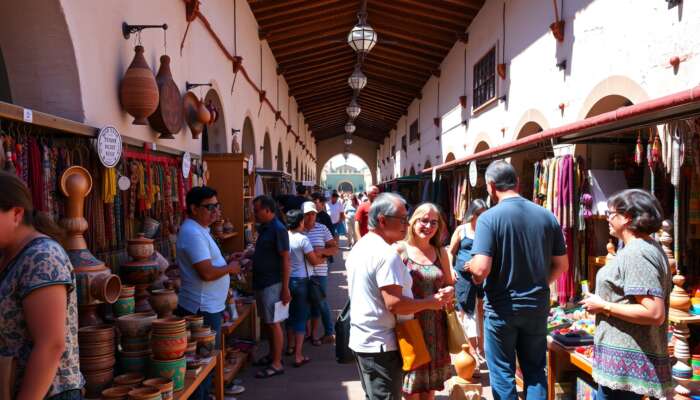
Respectful shopping is simple: greet the seller, handle fragile work only after asking, and ask permission before photographing people, products, demonstrations or private workspaces. A conversation about materials or technique can add useful context, but do not pressure a seller to provide personal details or a demonstration.
A useful phrase is “¿Puedo tomar una foto?” (“May I take a photo?”). If the answer is no, accept it without negotiation.
When is the best time to visit?
The best time depends on what you want from the visit. Earlier hours can make browsing easier, while later periods may feel busier and more social. The important distinction is between general crowd strategy and the actual operating schedule of a specific venue.
- Mercado de Artesanías: the current heritage-cities listing shows 9:00 a.m.–7:00 p.m. daily.
- Fábrica La Aurora: the venue currently lists 10:00 a.m.–6:00 p.m., with Sunday hours of 10:00 a.m.–5:00 p.m.; individual galleries can vary.
- Mercado Ignacio Ramírez: verify current hours directly before planning around a precise opening or closing time.
- Workshops, fairs and pop-ups: check the official tourism calendar or workshop contact because schedules can be seasonal or event-specific.
A practical half-day craft-shopping route
A simple half day works best when you move from broad browsing to more focused art and design rather than trying to visit every shopping venue in town.
- Start at Mercado de Artesanías. Walk the craft corridor once before making larger purchases so you can compare materials, styles and seller explanations.
- Add Mercado Ignacio Ramírez if you want food and everyday-market context. Treat it as a different market experience rather than another dedicated craft market.
- Pause before buying fragile or expensive pieces. Recheck size, packing, provenance and payment terms.
- Continue to Fábrica La Aurora if galleries and studios interest you. Its format is different enough to make a useful second stage rather than a repetition of the market.
Artisan markets in San Miguel de Allende: FAQ
What is the best artisan market in San Miguel de Allende for a first visit?
Mercado de Artesanías is the most direct starting point if your main goal is craft shopping. It concentrates many stalls along the Lucas Balderas craft corridor and is distinct from the neighboring Mercado Ignacio Ramírez, which is a broader municipal market.
For more detail, see our Where To Buy Authentic Handcrafts In San Miguel De Allende.
What kinds of handmade goods can I buy?
You may encounter metalwork, wool and other textiles, decorative objects, jewelry, ceramics and papier-mâché. Inventory varies, and not every item at every stall should be assumed to be handmade or locally produced.
How can I tell whether a craft is locally made?
Ask who made it, where it was made, what materials and techniques were used, and whether the seller is the maker or represents another producer. Visual appearance alone cannot prove local origin.
Should I bargain?
Ask politely rather than assuming negotiation is expected. Some sellers use fixed prices. If you are buying more than one item, it is reasonable to ask whether there is a different combined price and accept the answer without pressure.
Do artisan markets take credit cards?
Payment acceptance varies by vendor. Carrying pesos is practical, but ask each seller about card payment before committing to a purchase if that matters to you.
Should I choose a market, studio or boutique?
Choose a market for variety and side-by-side browsing, a studio or gallery complex for more direct artist or design context, and a boutique for a curated retail experience. None of those formats automatically guarantees that every item is local or handmade.
Recheck opening hours, holiday closures, payment methods, accessibility, workshop reservations and shipping with the venue or individual seller. Local markets and creative spaces change more quickly than evergreen travel guides do.

Clara Beaumont is a distinguished author and cultural enthusiast based in San Miguel de Allende. With a passion for exploring the diverse aspects of this vibrant city, she writes engaging pieces that illuminate its history, art, and community. Clara’s work aims to inspire both residents and visitors, fostering a deeper appreciation for the unique charm and rich stories that San Miguel de Allende has to offer.
I appreciate your breakdown of the different shopping experiences in San Miguel de Allende! It’s fascinating how each venue seems to cater to unique aspects of both shopping and cultural immersion. I’ve always been drawn to Mercado de Artesanías because it feels like a treasure hunt among the stalls, where each artisan has a story to tell through their craft.